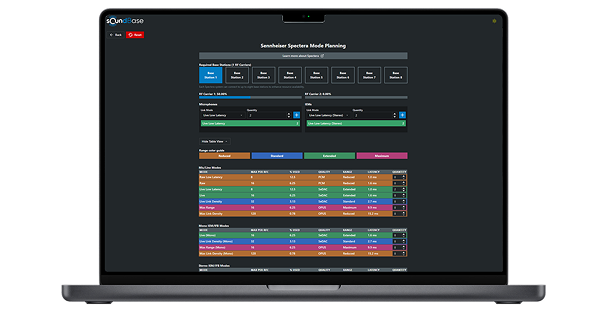
Let us recommend the right setup.


Part of the Evolution Wireless Digital family, EW-DX wireless microphone systems simplify your professional workflow by utilizing refined technologies and decades of research to deliver a digital UHF system that can be scaled with ease. With its advanced feature set and hardware options, even the most demanding professional applications benefit from a network-ready system that is designed to integrate seamlessly. The system quickly assesses your environment and uses equidistant channel spacing to deploy frequencies while tools like Sennheiser’s Control Cockpit, Wireless Systems Manager, and Smart Assist App allow you to monitor your system remotely. In-device charging, 12-hour battery operation, and switching bandwidth up to 88 MHz are only a few more of the many features that make EW-DX the right tool for the job.
The future of wireless pro audio is here — and it’s bidirectional. Featuring up to 64 channels (32 in/ 32 out) in a single unit, Spectera is the world’s first wideband, bidirectional digital wireless ecosystem, providing audio professionals with unparalleled capability and flexibility. Spectera’s 11 Audio Link modes give you unprecedented control of latency, audio quality and more for each link, while its bidirectional bodypacks manage both in-ear monitor and mic/line signals simultaneously.

Bidirectional wireless ecosystem; audio and control data in a single RF carrier for all components
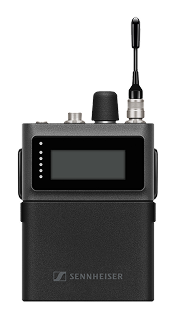
Bidirectional SEK bodypack manages both IEM and mic/line signals simultaneously
Transceiving antennas manage IEM signals, mic/line signals, and data simultaneously Continuous bidirectional communication for full remote control and monitoring of SEK bodypack links, IEM volume, audio level and settings, RF health, battery status, and more
Innovative Sennheiser WMAS technology accommodates an entire production in a single wideband RF carrier (6/8 MHz)
Integrated RF components in DAD antenna eliminate the need for additional dedicated RF gear such as combiners, splitters, or boosters
Bidirectional SEK bodypack manages both IEM and mic/line signals simultaneously
Transceiving antennas manage IEM signals, mic/line signals, and data simultaneously Continuous bidirectional communication for full remote control and monitoring of SEK bodypack links, IEM volume, audio level and settings, RF health, battery status, and more
Innovative Sennheiser WMAS technology accommodates an entire production in a single wideband RF carrier (6/8 MHz)

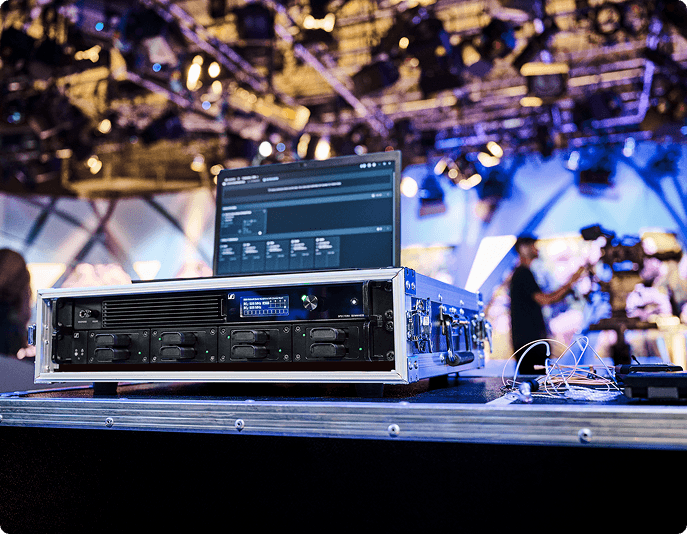
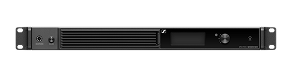
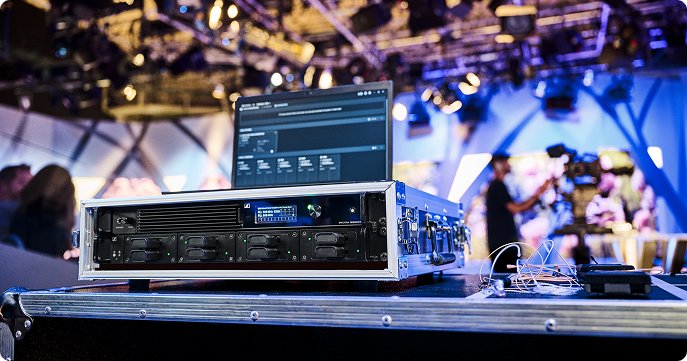
Spectera’s space-saving 1 RU base station features flexible digital I/O with redundant Dante and optional redundant MADI, assuring seamless integration into your audio network. Spectera’s transceiving antennas manage IEM signals, mic/line signals, and data simultaneously and up to four antennas can be connected for redundancy, extended zone coverage, or additional spectrum capacity. Spectera’s simultaneous 32 I/O enables advanced flexibility for wireless mic, instruments, and in-ear monitoring applications in a single system. Configurations are completely flexible and can include up to 32 mic/line channels and 16 stereo IEMs serving your talent on stage or 32 interruptible foldback (IFB) across your crew.

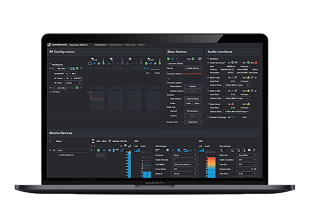
With Spectera’s bidirectional bodypacks, you have far more control and far fewer blind spots. Each Spectera SEK bodypack manages both an in-ear monitor and a mic/line input signal simultaneously. And with Spectera WebUI and SoundBase software, you have full remote control and monitoring of everything: IEM volume, audio level and settings, RF health, battery status, and more. So, you can spend more time in control and less time managing components and chasing surprises. For in-ear monitors, Spectera delivers unprecedented RF performance and stability — equivalent to digital wireless microphones. With Spectera, you get stunning IEM clarity and accuracy with ultra-low latency down to 0.7 milliseconds.


At the heart of Spectera is Sennheiser’s remarkable wireless multichannel audio technology (WMAS) and its unique modulation and multiplexing capabilities, which make Spectera vastly more resistant to dropouts and RF fading than narrowband systems. Spectera also features built-in redundancy where it matters most: redundant power supplies, redundant Dante and optional redundant MADI audio I/O, and the ability to connect multiple antennas for redundancy, additional zone coverage, or additional spectrum capacity.